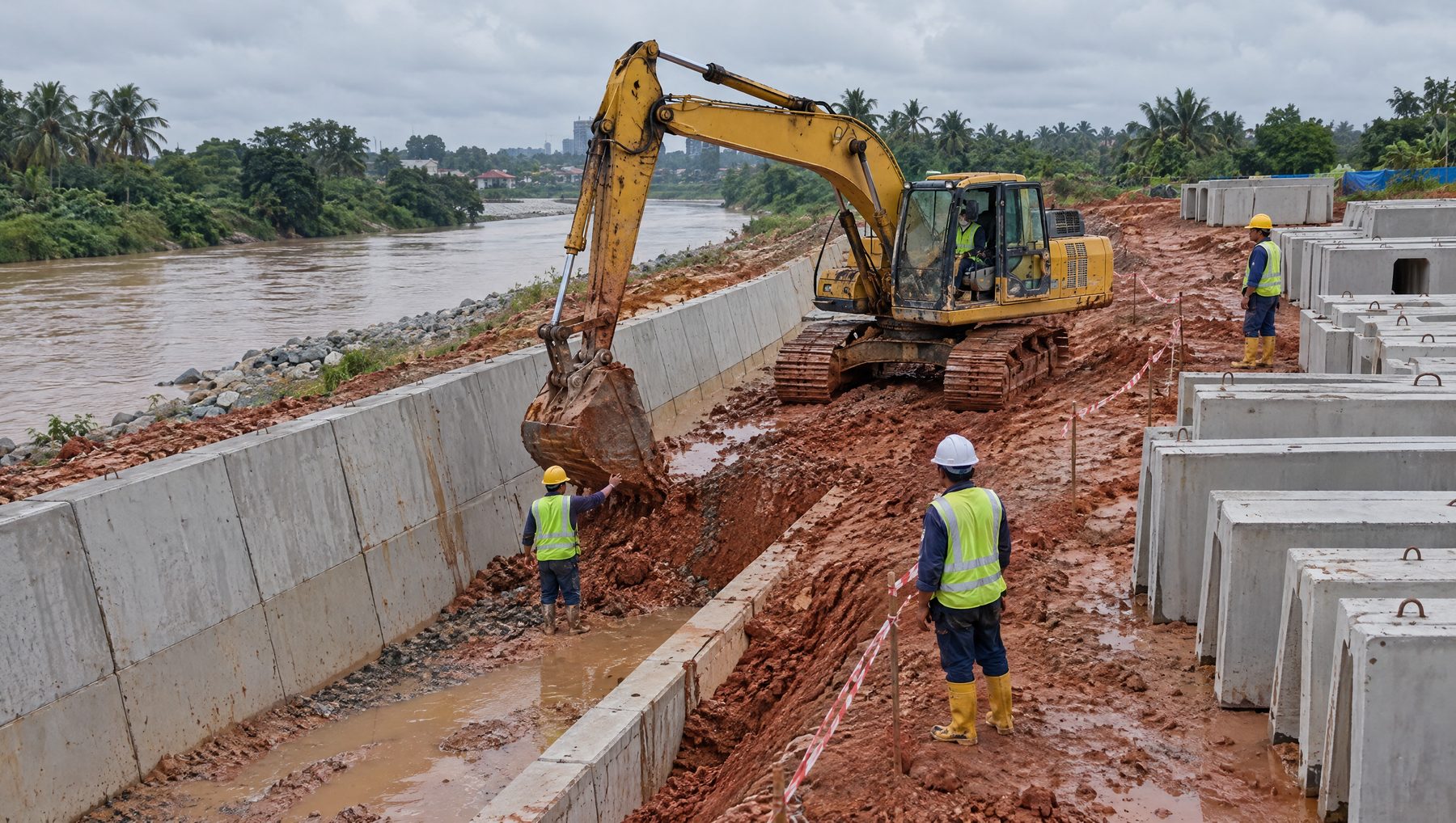
A flood mitigation project is most vulnerable to flooding while it's still being built. An open excavation, a diverted river, a cofferdam holding back a channel, a half-finished embankment: each is exposed to the exact monsoon the finished asset is designed to defeat. That is the central, and frequently underpriced, risk in this entire class of work.
Insuring flood mitigation infrastructure is primarily a Contractors' All Risks exercise: protecting the civil works, the plant and the parties involved in building flood-defence and drainage projects against physical damage and liability during construction.
This guide is written for the contractors, EPC firms, project owners and government-linked concessionaires building Malaysia's flood-defence pipeline, and for the CFOs and risk managers who structure the cover. It explains the programme, why these projects are an unusual construction risk, and where claims most often fall through.
Bidding for or building a flood mitigation project?
The cover that gets a flood project financed and signed off is not a standard property policy. Emerge structures Contractors' All Risks programmes for flood-defence and drainage works, including the flood, design and delay exposures that derail these projects.
The pipeline: why this is a large and growing class
Malaysia is spending at scale on flood defence, and the December 2021 floods, which caused an estimated RM6.1 billion in losses, accelerated it. Under the 13th Malaysia Plan covering 2026 to 2030, the government has allocated around RM20 billion for 103 flood mitigation plan (RTB) projects. Budget 2026 alone set aside RM2.2 billion for 43 flood mitigation projects, including 12 new ones.
These are large civil engineering contracts spread across the country: river basin works on Sungai Langat and Sungai Buloh in Selangor, Sungai Golok in Kelantan, the Sungai Johor and Sungai Muar basins in Johor, the Sungai Pahang basin, and Kuching in Sarawak. Pahang alone has 18 projects valued at around RM3.184 billion, including the Pekan flood barrier and Kuantan river basin works.
The category also includes landmark dual-purpose assets. The SMART tunnel in Kuala Lumpur, the world's first combined stormwater diversion and motorway tunnel at 9.7 km and built for around US$515 million, shows how large and complex a single flood mitigation asset can become. Every one of these projects needs a construction insurance programme behind it, and the bigger and more water-exposed the works, the harder that programme is to place well.
What Contractors' All Risks covers on a flood project
Contractors' All Risks (CAR) is the spine of the programme. It covers physical loss or damage to the permanent and temporary civil works during construction, plus liability to third parties arising from the works. For flood mitigation, that means the embankments, channels, retention ponds, barrages, drains and pumping-station civils that make up the asset.
CAR is usually arranged in the joint names of the employer and all contractors, so everyone with an interest in the works is covered under one policy. That avoids the situation where a subcontractor's loss becomes a liability dispute instead of a straightforward claim. The policy runs through construction and into the maintenance or defects liability period that follows handover.
| CAR element | What it covers on a flood mitigation project |
|---|---|
| Section I: Material damage | Physical loss or damage to the works, including embankments, channels, ponds and pump-house civils |
| Section II: Third-party liability | Injury or property damage to others caused by the works, including damage to adjacent land or structures |
| Temporary works | Cofferdams, river diversions, dewatering systems and access works critical to flood projects |
| Maintenance and defects period | Damage during the post-completion maintenance period, including defects that emerge after handover |
| Debris removal and professional fees | Clean-up and the consultant costs needed to reinstate after an insured loss |
Why flood mitigation works are an unusual construction risk
Most construction projects treat flood as one peril among many. On a flood mitigation project, flood is the peril, and it's pointed directly at the works. This inverts the usual risk conversation and it's where underwriting gets careful.
The exposure is concentrated in the temporary works and the construction sequence. A river diversion or cofferdam is holding back water by design, and its failure can wash out months of progress in hours. Dewatered excavations for pump houses and culverts flood if pumps fail or a storm exceeds the temporary capacity. A partially built embankment has none of the protection the finished structure will provide. The monsoon window, roughly November to March in much of Peninsular Malaysia, turns these from theoretical risks into scheduling problems.
Because of this, flood cover on these projects is the most negotiated part of the policy. Underwriters look closely at the construction method, the temporary works design, the flood management plan, and the contractor's track record on similar works. Flood is frequently sub-limited and carries a meaningful excess. A project that presents a credible flood management plan gets materially better terms than one that treats flood as a box to tick.
Is your flood cover sized for the works, or just bolted on?
The most expensive surprise on a flood project is discovering the flood sub-limit and excess at claim stage. Emerge runs a structured briefing for contractors and project owners on how flood, design and delay exposures should be structured before works begin. No obligation follows.
The full programme beyond CAR
CAR covers the works, but a flood mitigation project carries exposures that sit outside it. A complete programme assembles several policies around the contract, each closing a specific gap.
| Cover | What it protects | Why it matters here |
|---|---|---|
| Contractors' All Risks | The civil works and third-party liability | Core cover for the embankments, channels and ponds |
| Erection All Risks | Mechanical and electrical plant installation | Pumps, gates, penstocks and control systems in pumping stations |
| Delay in Start-Up (ALOP) | Revenue or financing cost lost if completion is delayed by an insured event | Relevant where the project is financed or run as a concession |
| Professional indemnity | The designers against errors in their professional work | Covers hydrological and geotechnical design error, which CAR does not |
| Performance bond | The owner against contractor default | Routinely required on government flood mitigation contracts |
| Marine cargo | Plant and materials in transit to site | Covers imported pumps, gates and specialist equipment before they arrive |
Two of these deserve emphasis on flood projects. Professional indemnity matters because the entire asset rests on design assumptions about flood levels and hydrology, and an error there is a design liability, not a construction damage claim. The performance bond matters because these are government-linked contracts where the owner expects security against default, and a bond is not insurance, it's a separate surety instrument that sits alongside the CAR programme.
Who carries the exposure
On a flood mitigation project the risk is shared across several parties, and the contract decides who insures what. Getting this clear before works begin is the difference between a clean claim and a multi-party dispute.
| Party | Primary exposure | Cover that responds |
|---|---|---|
| Main contractor or EPC firm | Damage to the works, liability, delay and default | CAR and EAR in joint names, third-party liability, performance bond |
| Project owner or employer | Loss of the asset, contractor default, completion risk | Named insured on CAR, performance bond, delay cover where financed |
| Government-linked concessionaire | Construction risk plus future revenue or availability | Full construction programme plus Delay in Start-Up |
| Designer or consulting engineer | Errors in hydrological, structural or geotechnical design | Professional indemnity |
| Financier or lender | Impairment of the security or the cash flows funding the project | Bankable programme with the lender's interest noted |
Where claims fall through
The recurring failures on flood mitigation projects are not exotic. They come from the cover being assembled without anyone owning the joins between policies.
The most common is the flood sub-limit and excess. A project insures the works, assumes flood is covered, and discovers at claim stage that flood is sub-limited well below the loss and carries a heavy excess, on the one peril most likely to hit. The second is the design gap, where a failure traced to a design assumption falls between the CAR policy, which limits defect cover, and a professional indemnity policy that was never arranged or was underbought. The third is the bond-versus-insurance confusion, where a project treats a performance bond as if it were damage cover and finds it responds only to contractor default.
| Failure mode | What goes wrong | How it's avoided |
|---|---|---|
| Flood sub-limit and excess | Flood is sub-limited below the loss and carries a heavy excess, on the most likely peril | Size flood cover to the works and the flood management plan, not to the premium |
| Design gap | A design-related failure falls between limited CAR defect cover and absent professional indemnity | Arrange adequate designer professional indemnity alongside the CAR programme |
| Bond mistaken for insurance | A performance bond is treated as damage cover and responds only to contractor default | Hold both: a bond for default and CAR for physical damage |
None of these are pricing problems. They're structuring problems, and they're avoidable when the programme is built around the specific construction sequence and contract rather than bought off a generic schedule. For broader context on how construction and engineering risk is placed in the region, see the Construction and Engineering sector overview.
FAQ
What insurance does a flood mitigation project need?
A flood mitigation project typically needs Contractors' All Risks cover for the civil works, Erection All Risks for the mechanical and electrical plant, third-party liability, and often Delay in Start-Up, professional indemnity for the designers and a performance bond. The exact programme depends on the contract structure, the financing, and what the project owner requires.
What is Contractors' All Risks (CAR) insurance?
Contractors' All Risks is a construction insurance policy that covers physical loss or damage to civil engineering works during the build, together with third-party liability arising from the works. For flood mitigation projects such as embankments, channels, retention ponds and pumping stations, it's the core cover that protects the works in progress.
Why are flood mitigation projects especially exposed during construction?
Flood mitigation works are built in and around watercourses, often during or close to the monsoon season they're designed to control. Open excavations, cofferdams, diverted rivers, dewatering systems and half-built embankments are highly vulnerable to the very flooding the finished asset will prevent, which makes water damage a central construction risk rather than a remote one.
Does Contractors' All Risks cover flood damage to the works being built?
It can, but flood is the peril underwriters scrutinise most on these projects, precisely because the works sit in flood-prone locations. Flood cover is often sub-limited and carries a significant excess, and the terms depend heavily on the construction method, the temporary works and the contractor's flood management plan. This is a negotiation, not a given.
What is the difference between a performance bond and insurance?
A performance bond is a surety instrument that guarantees the project owner compensation if the contractor fails to perform its contractual obligations. Insurance indemnifies the insured for loss or damage from insured events. A bond protects the owner against contractor default, while Contractors' All Risks protects the works against physical damage, so a major project usually needs both.
Who is responsible for insuring a flood mitigation project?
Responsibility is set by the contract. Under many government and EPC contracts the main contractor arranges the Contractors' All Risks programme in the joint names of the employer and all contractors, while the owner may carry separate cover and require performance bonds. Designers carry their own professional indemnity. Clarifying who insures what before works begin avoids gaps and disputes.
Does Contractors' All Risks cover design errors in flood infrastructure?
Standard Contractors' All Risks cover treats design defects in a limited way, and the level of defects cover is negotiated rather than automatic. Pure design liability, such as an error in hydrological or geotechnical design, sits with the designer's professional indemnity policy. On flood projects, where design assumptions about flood levels are central, this distinction matters a great deal.
Emerge Conclusion
Flood mitigation is one of the few construction classes where the headline peril is aimed straight at the works during the build, and where the cover for that peril is the part most likely to be quietly sub-limited. With RM20 billion of projects in the national pipeline, the contractors and owners who win and deliver them cleanly are the ones whose insurance is structured around the flood, design and delay exposures, not bought off a generic schedule.
The question to ask before your next bid is direct: if the monsoon washed out your cofferdam and three months of works tomorrow, is your flood cover sized to pay it, or is it the line that's been sub-limited to make the premium look good? If you're not certain, that's the exposure to close before site works start.
Request a construction coverage review from the Emerge team →
Disclaimer: This article provides general guidance on construction insurance available in the Malaysian and Southeast Asian markets as of July 2026. Policy wordings, sub-limits, excesses and exclusions vary significantly between carriers and projects. Regulatory and procurement frameworks referenced may be amended. Always review specific policy wordings and consult a qualified broker before making coverage decisions.