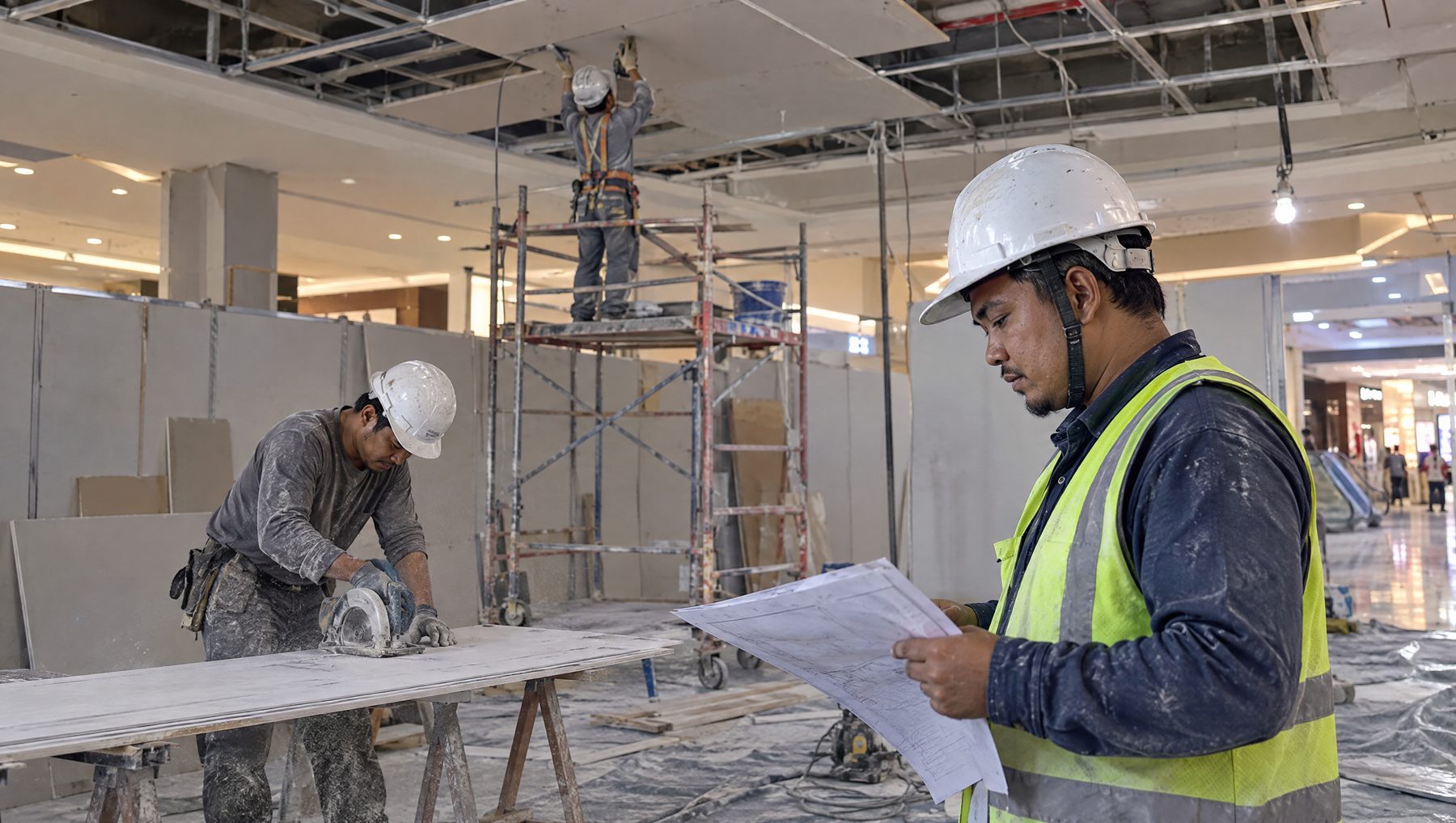
The riskiest moment in a mall's life isn't a fire in year ten. It's the refurbishment, when contractors, hot works, dust and an opened-up roof sit directly above tenants who are still trading. The finished asset will be worth more, but during the works the building is more exposed than at any point in its normal operating life, and the standard property policy was not written for that state.
Contractors' All Risks insurance for a refurbishment covers physical loss or damage to the works, materials, plant and machinery, plus third-party liability, and it can be extended to cover the existing structure, which is the exposure real estate owners most often miss.
This guide is for owners and asset managers running value-add work on hotels, malls and industrial assets across Asia. It's a decision piece: when your property policy is enough, when you need a project policy, and where the expensive gaps sit.
Planning a refurbishment or redevelopment?
The gap between your property policy and a project policy is where refurbishment losses fall through. Emerge structures Contractors' All Risks cover for value-add work across the region, including the existing-structure and loss-of-rent exposures.
The decision: does this project need its own policy?
Small, cosmetic works within an operating asset may sit under a property policy with the insurer's agreement. Anything structural, anything involving hot works, and anything a lender or contract requires to be separately insured needs its own Contractors' All Risks cover. For value-add real estate, that's most projects.
The trigger to watch is the nature and value of the work relative to the building. Once the works involve meaningful construction activity, or the project value is significant against the asset, the property policy is the wrong instrument. It wasn't priced or worded for a live construction site, and relying on it can leave both the works and the existing building exposed.
| Your project | Cover approach |
|---|---|
| Minor cosmetic works, asset operating normally | May sit under the property policy, with the insurer's written agreement |
| Structural refurbishment or repositioning | Dedicated Contractors' All Risks policy, existing structure addressed |
| Full redevelopment or major extension | Project Contractors' All Risks plus Delay in Start-Up and liability |
| Tenant fit-out in a building you don't own | Coordinate tenant works cover with the landlord's building policy |
The existing-structure gap
This is the single most important point in refurbishment insurance, and the one that catches owners out. When you refurbish an existing building, there are two things at risk: the new works, and the building that's already standing. Contractors' All Risks naturally covers the works. The existing structure is a different question.
The default position is that the owner insures both the existing building and the contract works. Construction insurers will often agree to include the existing structure within the Contractors' All Risks policy, but typically only where its reinstatement value is comparable to the value of the new works and, crucially, where the building is unoccupied during the project. On a value-add deal, neither of those conditions may hold.
Here's the exposure. If a fire during the refurbishment spreads from the works into the standing building and the existing structure wasn't properly insured under either the project policy or a maintained property policy, the owner can be left carrying the loss on the most valuable part of the asset. This has to be resolved before work starts, by deciding deliberately which policy covers the existing structure and confirming the values line up.
Refurbishing an occupied or trading asset
Value-add rarely happens in an empty building. Hotels renovate floor by floor while still taking guests. Malls refit units while the rest keeps trading. Industrial assets are repositioned while part of the operation continues. Each of these raises the risk profile and the underwriting scrutiny.
An occupied refurbishment stacks construction hazards on top of a live building. Hot works near combustible finishes, water escape into occupied areas, dust affecting tenants, and temporary changes to fire escape routes all increase both the property and the liability exposure. Insurers will want a clear method statement, a hot-works permit system, and evidence that fire safety is maintained around the works.
Two covers rise in importance here. The existing-structure element, because the building you're protecting is full of people and trading value, and public liability, because members of the public and tenants are on site throughout. Getting these coordinated with the base building policy is the difference between a clean claim and a fight over which policy responds.
Refurbishing while the asset keeps trading?
Occupied refurbishments are where the existing-structure and liability gaps do the most damage. Emerge runs a 30-minute review of a planned project, mapping the works cover against the base building policy so nothing falls between them. No obligation follows.
Protecting the return: loss of rent and delay
A value-add project has a business case built on a completion date and a rental uplift. An insured event that delays completion doesn't only cost the repair, it pushes back the income the whole deal depends on. Contractors' All Risks pays for the physical damage. It doesn't, on its own, pay for the lost time.
Delay in Start-Up cover, also called Advance Loss of Profits, closes that gap. It responds when an insured event delays the project and defers the rental income or revenue the completed asset was expected to earn. For a debt-financed value-add deal, this is what protects debt service and the return during a delay, and it's often required by the financing.
The programme around a serious refurbishment therefore has several parts working together, each closing a specific gap.
| Cover | What it protects |
|---|---|
| Contractors' All Risks | The works, materials and plant, and third-party liability from the works |
| Existing structure extension | The standing building the works are carried out on |
| Delay in Start-Up (ALOP) | Rental income deferred by an insured delay |
| Professional indemnity | The designers against errors in their professional work |
| Ordinance or law cover | Extra cost of rebuilding to upgraded building codes after a loss |
The fit-out ownership problem
Fit-outs create a specific complication: the party doing the work often doesn't own the building. A tenant fitting out leased space, or an owner whose asset is one strata unit in a larger building, sits in a split-responsibility situation that the paperwork has to resolve.
Typically the tenant insures its own works and the landlord insures the base building, and the two policies need to be coordinated so that damage flowing from the fit-out into the base building is clearly covered somewhere. Where the employer doesn't control the whole building, this usually means negotiating with the landlord before work begins. Left unresolved, a fit-out fire that damages the base building becomes a liability dispute rather than a straightforward claim. For owners holding assets across several markets, this coordination should also fit the wider cross-border property programme rather than being handled project by project in isolation.
| Common gap | What goes wrong | How it's closed |
|---|---|---|
| Existing structure | The standing building isn't insured under any policy during works | Add an existing-structure extension or confirm the property policy responds |
| Occupied or trading refurbishment | Hot works and public liability on a live building are underestimated | Method statement, hot-works permits and coordinated public liability |
| Loss of rent | A delayed completion defers rental income the deal relies on | Delay in Start-Up (ALOP) cover sized to the project |
| Fit-out ownership | Tenant works and base-building responsibility are unclear | Agree cover with the landlord before works start |
FAQ
What is Contractors' All Risks insurance for a refurbishment?
Contractors' All Risks insurance for a refurbishment covers physical loss or damage to the works, materials, plant and machinery involved in the project, plus third-party liability arising from the work. For a refurbishment of an existing building it can also be extended to cover the existing structure, which is the part owners most often overlook.
Does Contractors' All Risks cover the existing building during a refurbishment?
Only if the existing structure is specifically included. The default is that the owner insures both the existing building and the works, but insurers will often include the existing structure under the Contractors' All Risks policy only where its reinstatement value is comparable to the works and the building is unoccupied. Where that's not the case, the existing structure has to be addressed deliberately.
Can you refurbish a hotel or mall while it stays open under a Contractors' All Risks policy?
Yes, but occupied or trading refurbishments change the risk and the terms. Hot works, dust, water and altered fire escape routes in a building still serving guests or tenants raise the exposure, and insurers will want a clear method statement and fire-safety controls. The existing-structure and public-liability elements become more important, and cover has to be arranged around the fact that people are still using the building.
Does Contractors' All Risks cover loss of rent if a project overruns?
Not by itself. Loss of rent or revenue from a delayed completion is covered by Delay in Start-Up or Advance Loss of Profits cover, arranged alongside the Contractors' All Risks policy. It responds when an insured event delays the project and pushes back the rental income the finished asset was expected to earn.
Who insures a fit-out, the tenant or the landlord?
It depends on the lease and the scope, and it's a common source of gaps. Where a tenant is fitting out space in a building it doesn't own, the tenant typically insures its own works while the landlord insures the building, and the two need to be coordinated. Clarifying responsibility with the landlord before work starts avoids disputes over damage to the base building.
What does Contractors' All Risks not cover in a refurbishment?
Common exclusions include defective design and workmanship to the extent negotiated, wear and tear, and consequential losses beyond any delay cover arranged. Pure design liability sits with the designer's professional indemnity policy. The existing structure is excluded unless specifically added, and costs to meet upgraded building codes need ordinance-or-law style cover to respond.
Emerge Conclusion
Value-add is where real estate returns are made, and where the insurance is most often wrong. The works are the easy part to cover. The existing building, the trading tenants, the deferred rent and the split responsibility on a fit-out are where refurbishment losses actually fall through.
The question to ask before your next project starts is which policy covers the standing building if a fire spreads from the works, and whether your delayed rent is protected if completion slips. If those answers aren't clear, that's the exposure to close before the contractor mobilises.
Request a project coverage review from the Emerge team →
Disclaimer: This article provides general guidance on construction insurance for refurbishment and value-add projects available in Asian markets as of July 2026. Policy wordings, extensions and exclusions vary significantly by carrier and project. Always review specific policy wordings and consult a qualified broker before making coverage decisions.